
Dawson Trotman
Man by Man, Ship by Ship -- Touching Lives from Lomita to the Ends of the Earth

Dawson Trotman’s father moved out when he was a little boy; His mother worked at Woolworth's and saved every dime in a little bank on the dresser.
Daws spent hours sitting on the floor staring at that bank: Mother won’t notice if one of the dimes is gone. He slit it open and out fell the dimes. All were properly returned but one. Daws used the dime to buy a whole pack of chocolates.
Looking back later, he said, “How I wish I had been caught then!” For this small act of theft set a trajectory for Daws: Over the next ten years, he stole hundreds of dollars from his employer and took advantage of his role as student body president to steal from the school funds. Daws was, as he later described, “sick at heart”.
This whole time, however, Dawson’s life was a display of success and goodness. He was handsome. Smart. Strong. As a boy scout he, “took the oath to be ‘trustworthy, loyal, helpful, friendly, courteous, etc.’” He attended church, worked at the lumberyard, dated a Christian girl, graduated high school as valedictorian and student body president, and led the Lomita Presbyterian Church Christian Endeavor Society.
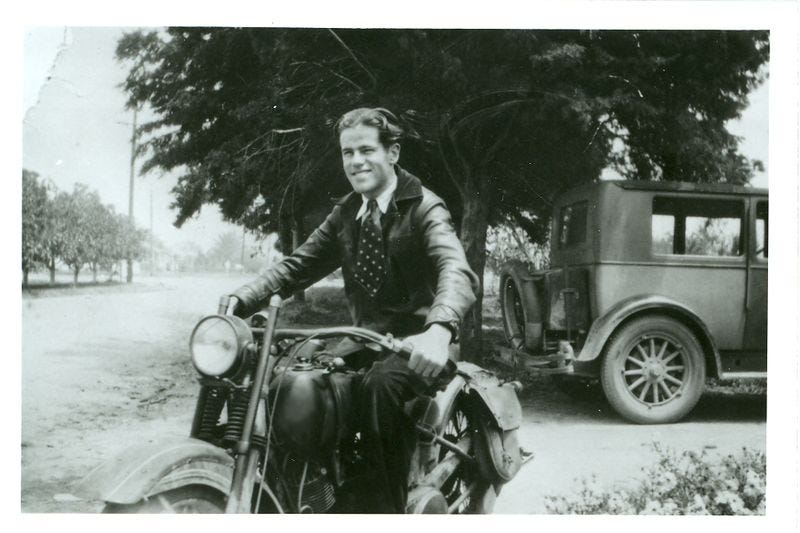
Daws on Motorcycle, 1920s – “My subject was ‘Morality versus Legality,’ yet I was stealing from the school funds. Such is the deceit of the human heart.”
Photo courtesy of The Navigators History Department.
Big acts of evil almost always follow little acts–little thoughts–of evil. Throughout his teens Daws drifted further and further away from all that is good. His heart became accustomed to theft, deceit, and resistance to God. All this culminated in high school graduation night, when Daws, “ditched that Christian girl and went out with a beautiful unsaved girl.”
It was on that night that Daws completely gave up: His reputation, his half-attempts at goodness, his mother’s pleas to do what is right. “I just can't do what is right. It's not in me to be good. I guess I'm one of those guys who just can't win.”
Daws had never touched alcohol before – that week he went out and got drunk. Soon he was going to the beer joints every night: drinking late, partying, and gambling. His mother was bedridden with cancer and begged him, “Son, you're breaking my heart. I'm praying for you, but you know, I'm afraid if I ever hear that you are in jail, I'll die. It will kill me.”
Four times that year, Daws was pursued by police. Four times he had to be rescued by ambulances. He became quite familiar with the inside of jail. And one night he nearly drowned while swimming across a lake with his girlfriend.
During these moments of desperation, Daws would sometimes remember God. O God, please just let me out of this! I’ll do anything you want me to if you let me out of this mess! But he would inevitably forget and return to his worldly pleasures.
The funny thing about a life of worldly pleasure is that it isn’t pleasant. It’s a life of death. A big police officer caught Daws while he was under the influence, and, holding him tightly by the arm, asked, “Do you like this kind of a life?” Daws cried, “Sir, I hate it!”
The policeman sighed. He took Daws to a park and waited till he was sober and made him promise he’d be better.
So that Sunday, Daws decided to visit church again. Some students were gathered, challenging each other to a competition. They had a list of ten Bible verses – each verse worth five points. The team with the least points next Sunday would buy lunch for the winners.
Daws went home. He spent Monday, Tuesday, Wednesday, Thursday, Friday, and Saturday nights at the beer joint. Then on Sunday he returned to church – sneaking past the pool hall, only 2 blocks away, so that his gambling buddies wouldn’t see him.
That night he earned his team 50 points: He’d memorized all ten verses. He was given another ten for next week.
As the week began, a couple of Dawson’s schoolteachers prayed for him. Daws later reflected, “Miss Mills was a general science teacher, and I was one of her problem pupils. She wrote my name on her prayer list and prayed for me every day for six solid years.”
And Daws needed it. Yet again he spent the week at the beer joint. He returned on Sunday with all ten verses memorized. His team won.
As the third week began, verses kept popping into Dawson’s head: I am the bread of life. Carry each other's burdens. Whoever believes in me gets eternal life. “Those words ‘hath everlasting life’ stuck in my mind. I said, ‘O God, that's wonderful -- everlasting life!’… There for the first time I remember praying, after I had grown to be a man, when I was not in trouble with the police or something like that. I said, ‘O God, whatever this means, I want to have it.’” So there, in the middle of the week, walking to work with his lunch pail in hand, Daws accepted Jesus into his heart.
Dawson didn’t know much about what life in Jesus looked like, but he plunged fully into it. He began memorizing one Scripture verse a day, soon reaching his first thousand. He read the Bible verse that said, “While it was still dark, Jesus got up, left the house, and went off to a solitary place, where he prayed” (Mark 1:35), so he and his friend decided to do so too. Every day (including Sundays) they drove up into the hills and prayed together from 5 to 7am. “We decided to ask first for the things that we were doing and for the people around us and to keep our hearts open, so that God could widen our interests to the fullest extent.”
This included prayer for a small Sunday school class: Even in his infancy as a Christian, Dawson had decided to take on a class of 6 boys. The Sunday school superintendent prayed for Dawson, warning him that, “two teachers have already given up; they could not get these boys to listen.”
At that point in his life, Daws didn’t have good theology, and he had no experience evangelizing, but he trusted in Jesus and prayed for God’s help. Not only did he get those six boys to listen – he grew that Sunday school from 100 to 400 kids, with 225 boys accepting the Lord.
In their early morning prayer times, Dawson and his friend began praying for bigger and bigger things. By the fourth week they were praying that they might touch the lives of people in all 48 states. By the sixth they brought a map of the world with them to the hills and prayed that they might touch the lives of men across the globe.

Trotman’s World Map – “We began to put our fingers on Germany, France and Italy. We put them on Turkey and Greece. I remember looking at one little island near China -- you had to look close to see what it was -- and we prayed that God would use us in the lives of men on Formosa.”
Photo courtesy of The Navigators History Department.
These hours spent praying to God, memorizing Scripture, leading others to Christ, and actively relying on God’s strength laid a solid foundation for Dawson’s life. He later reflected on the importance of setting aside time for the Lord: “If you cannot take 1/48th of your day to be alone with your mighty God and King, I rather doubt that He is going to do very much through you.”
God certainly worked many good things through Dawson. It started small: morning prayers, Sunday school class, one-on-one discipleship with sailors, and hospitality at the family dinner table with his wife Lila.
But in each of these small moments, Dawson lived radically for the Lord: Praying to touch the lives of men across the globe, trusting God despite a “fear in soul winning,” (yes—every single time he stepped up to evangelize, Dawson was afraid) and giving up Sunday afternoon swimming to preach God’s Word.
This total surrender to God soon produced great fruit. Other cities noticed the growth of Dawson’s Sunday School and asked him to help them do the same. Dawson’s investment of months discipling just one sailor led to a small Bible study of sailors, which exponentially grew to discipleship groups of sailors populating over 1,000 ships and military installations by the end of World War II. Today, this work is known as the Navigators, a ministry that disciples Christians through one-on-one mentorship.
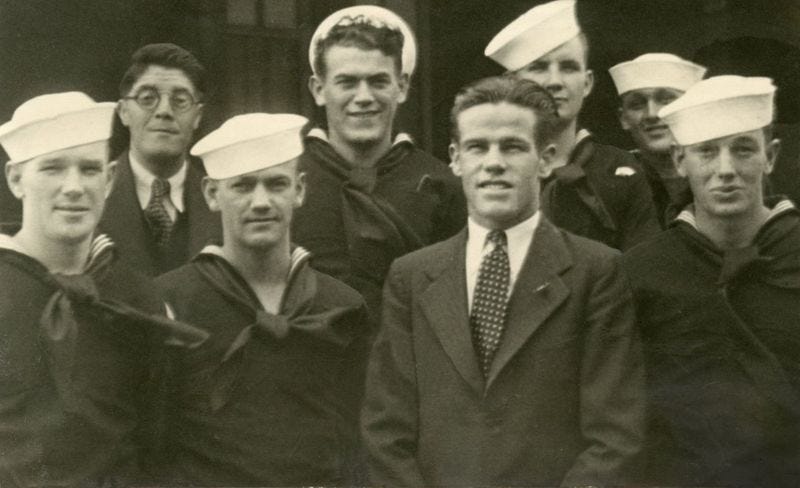
The First Navigators, 1934 – “When the war closed, there was work by one or more producers (I am not talking about mere Christians), on more than a thousand of the U.S. Fleet ships and at many army camps and air bases.”
Photo courtesy of The Navigators History Department.
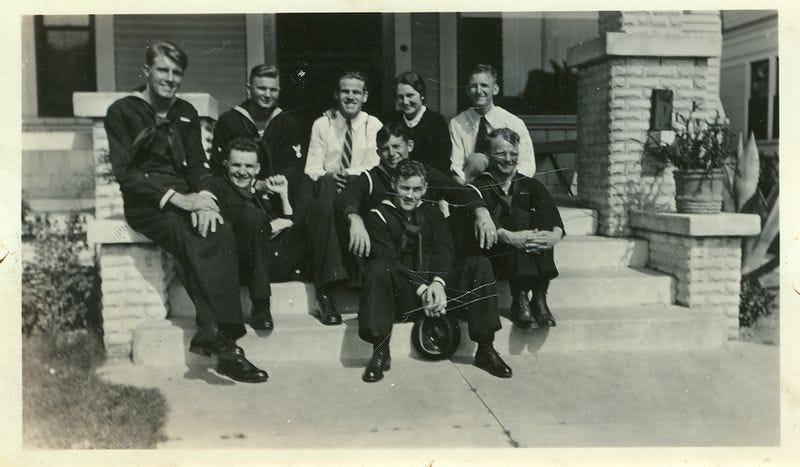
Dawson and Lila Trotman with Sailors, 1930s – “I believe with all my heart that one of the greatest soul saving stations in the world is the home.”
Photo courtesy of The Navigators History Department.
Dawson’s work with the Navigators led to an unexpected partnership. At the time, Billy Graham was preaching the gospel to billions of people through the crusades, and is estimated to have led at least 3 million to Christ. But Billy knew that many of these tender new Christians would wither and return to their old lives unless they were tended to. So he asked Dawson to start a follow-up program: “Look, Daws… everywhere I go I meet Navigators. I met them in school in Wheaton. They are in my school right now. There must be something to this.”
Dawson pushed back – he had always worked on a relational level, and couldn’t envision starting a program for millions of people. Besides, he didn’t have enough time.
But Billy continued to press. And Dawson knew that without continued support and discipleship, the work of conversion often goes to waste. He remembered how, years before, an act of successful evangelism proved fruitless in the long run:
It was a hot summer’s day. Dawson prayed that God would send someone along with whom he could share the Good News. After a few minutes, he saw a hitchhiker on the side of the road. As Dawson pulled over, the young man climbed into the car and said, “Jesus Christ! It’s hard to get a ride these days!” Dawson pulled out his Bible and handed it over, saying, "Lad, read this."
The hitchhiker suddenly recognized Dawson: One year before, he’d been hitchhiking the same road, climbed into Dawson’s car, used God’s name in vain, found a Bible in his hand, and by the end of the ride he’d accepted Jesus Christ as his Savior.
Dawson and the hitchhiker realized that this ‘conversion’ had done no good. The hitchhiker was the exact same man as before.
Dawson believed that what the hitchhiker (and the millions of crusader converts) needed was consistent discipleship. So he accepted Billy’s invitation. He designed a Crusades follow-up program that incorporated Bible studies, discipleship, and Scripture memorization. He could often be found personally disciplining the crusaders himself. Over time – just like his work with the sailor and the 6 Sunday school boys – Dawson’s consistent faithfulness reaped great fruit. He helped millions of early converts become rooted in Christ.
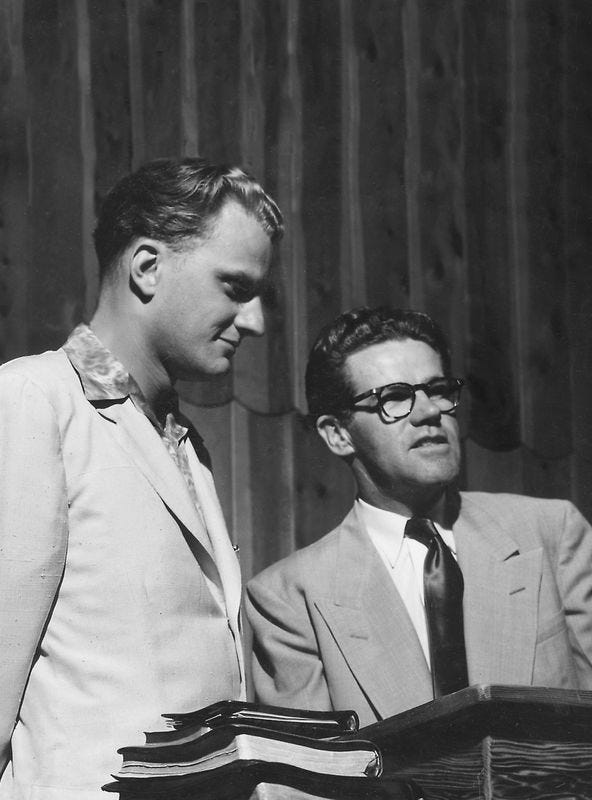
Billy Graham and Dawson Trotman Teaching, 1950s – “I had said to him that day before I left for Formosa, "Billy, you will have to get somebody else." He took me by the shoulders and said, "Who else? Who is majoring in this?""
Photo courtesy of The Navigators History Department.
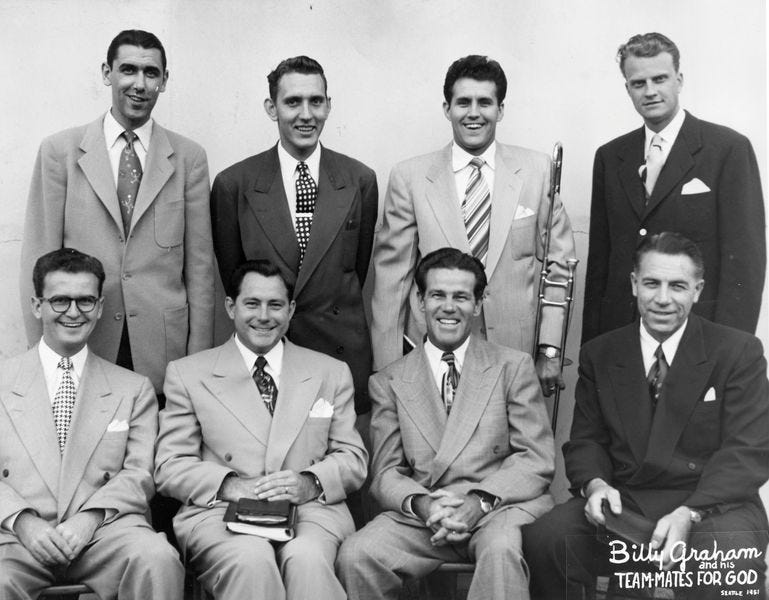
Billy Graham and His Teammates for God, 1951 – “How thrilled we are to see the masses fill up the seats! But where is your man?”
Photo courtesy of The Navigators History Department.
Day after day Daws shared the good news that God had transformed his life. He discipled and walked with young converts. He studied and preached God’s word. He memorized scripture and cared for Lila and their 5 young children.
In 1956, Dawson visited a lakeside camp to share his testimony. It was early afternoon, and Daws joined a small group on a boat ride. When they reached the middle of the lake, the water started getting choppy.
All of a sudden, a sharp bounce threw Daws and a camp girl up into the air and down into the water. In seconds the speeding boat left them far behind. The girl couldn’t swim. Dawson was an energetic, vigorous 50-year-old: he swam to the girl through the heavy water, and struggled to hold her up as the waves pressed on and on.
Finally the boat circled back. They pulled the girl up just in time – but they couldn’t see Dawson anywhere. They desperately searched and circled and dove for him, but his body had already sunk from exhaustion. Dawson Trotman drowned in Schroon Lake, June 18, 1956, saving a girl’s life. Billy Graham noted at his funeral that, “Daws died the same way he lived—holding others up.”
Yes, I echo what Carson said below. I knew of Dawson Trotman -ofter heard his name in my work with Campus Crusade for Christ, but I didn't know his story. Thank you for give us this insight. So encouraging - a faith builder.
I've heard of Dawson Trotman several times but I had no idea he was this impressive. Great job!!